Strategic Cartography — Canonical Glossary (v1.0)
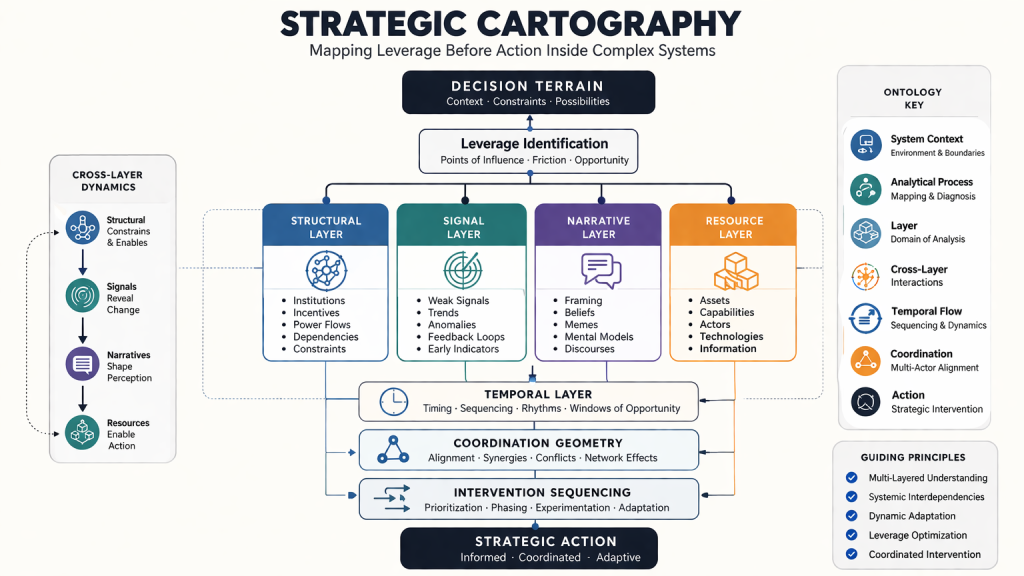
Strategic Cartography is the discipline of mapping leverage before action inside complex participation systems.
The vocabulary below defines its core analytical components and operational geometry.
I. Core Discipline Terms (Foundation Layer)
Strategic Cartography
Mapping leverage before action inside complex human systems.
Decision Terrain
The structured landscape of constraints, actors, signals, narratives, and resources within which action occurs.
Participation System
The total structure through which actors enter, move within, and influence a coordinated effort.
Coordination Geometry
The spatial and relational structure governing how actors align behavior across time.
Leverage Identification
Detection of points where small interventions produce disproportionate system change.
Intervention Sequencing
Ordering actions according to dependency structure and timing constraints.
System Boundary Detection
Determining where the mapped system meaningfully begins and ends.
II. Structural Mapping Layers
Structural Layer
Institutions, roles, infrastructure, and durable constraints shaping participation.
Signal Layer
Observable indicators of movement, readiness, friction, or alignment.
Narrative Layer
Meaning frameworks that shape interpretation, legitimacy, and motivation.
Resource Layer
Flows of capital, talent, authority, logistics, and attention.
Temporal Layer
Timing windows, pacing cycles, and irreversible transitions.
Legitimacy Surface
Distribution of perceived authority across actors and institutions.
Constraint Field
The pattern of forces limiting available action.
III. Actor Geometry
Actor Node
An individual or institution capable of influencing system movement.
Influence Vector
Direction and magnitude of an actor’s effect on the system.
Alignment Gradient
Degree of agreement between actors and system objectives.
Participation Threshold
Minimum conditions required for an actor to engage.
Adoption Curve
Rate at which actors enter participation states.
Coalition Geometry
Structure formed by aligned actor clusters.
Authority Topology
Arrangement of formal and informal power relationships.
IV. Signal Interpretation
Signal Density
Volume of meaningful indicators within a system region.
Signal Reliability
Confidence level associated with observed indicators.
Signal Latency
Delay between system change and signal visibility.
Signal Convergence
Multiple indicators pointing toward the same system shift.
Signal Divergence
Conflicting indicators across layers.
Signal Amplification Node
Locations where signals rapidly propagate outward.
V. Narrative Dynamics
Narrative Attractor
A story structure that stabilizes interpretation across actors.
Narrative Drift
Gradual change in dominant meaning frameworks.
Narrative Lock-In
Condition where alternative interpretations become difficult.
Narrative Cascade
Rapid spread of interpretive alignment.
Narrative Fracture Point
Moment when shared interpretation destabilizes.
Legibility Window
Period during which a system’s meaning structure is especially interpretable.
VI. Resource Motion
Resource Corridor
Stable pathway through which support flows.
Resource Bottleneck
Constraint limiting throughput capacity.
Activation Energy
Minimum investment required to initiate participation.
Mobilization Surface
Distribution of readiness across participants.
Deployment Vector
Direction resources move once activated.
Support Elasticity
Responsiveness of resources to intervention.
VII. Temporal Strategy
Strategic Timing Window
Period when intervention probability of success is highest.
Irreversibility Threshold
Point beyond which system change cannot easily be undone.
Synchronization Moment
Alignment of actors, signals, and resources in time.
Momentum Transfer
Carry-forward effects from earlier interventions.
Sequencing Dependency
Requirement that one action precede another.
Pacing Rhythm
Cadence governing sustainable intervention tempo.
VIII. Terrain Interpretation
Participation Surface
Map of actor readiness across the system.
Influence Gradient
Rate of change in persuasive capacity across regions.
Engagement Basin
Zone where actors naturally accumulate participation.
Resistance Ridge
Region where adoption slows or reverses.
Opportunity Basin
Area of unusually low activation cost.
Stability Plateau
Region resistant to rapid system movement.
IX. Intervention Design
Leverage Point
Location where small action produces large structural effect.
Entry Vector
Path through which intervention enters the system.
Coordination Pivot
Actor or structure capable of reorienting alignment.
Activation Pathway
Route converting passive actors into participants.
Cascade Trigger
Event initiating rapid multi-layer change.
Stabilization Anchor
Element preventing regression after intervention.
X. System Evolution
Participation Cascade
Self-reinforcing expansion of engagement.
Alignment Regime
Stable configuration of actor coordination.
Constraint Realignment
Shift in limiting structures after intervention.
System Reindexing
Change in how actors interpret their position in the terrain.
Legitimacy Transfer
Movement of authority between actors or institutions.
Strategic Phase Transition
Rapid shift from one participation regime to another.